

The Schism
How ACIP broke ranks with the medical religion

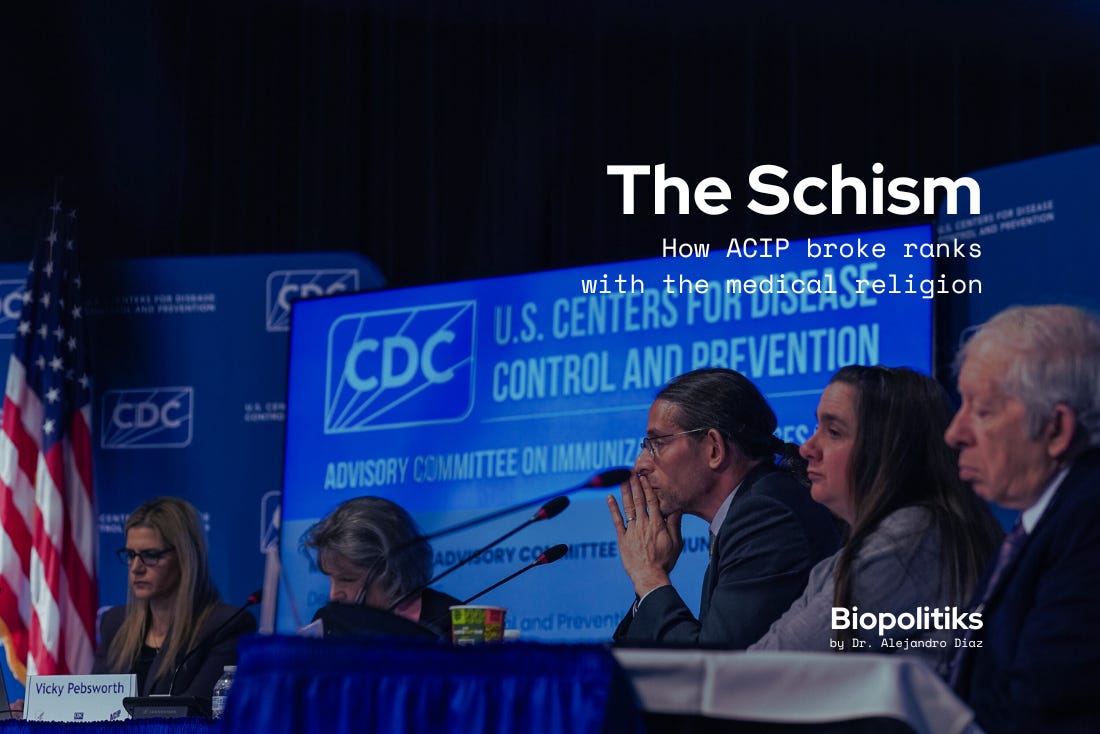
For decades, vaccine policy has functioned less like science and more like religion. Its doctrines were proclaimed from the pulpits of medical schools and federal agencies, its rituals enforced in delivery rooms, and its clergy, the physicians, pediatric associations, and public health officials, were entrusted to guard the sacred orthodoxy. To question the universal hepatitis B birth dose was to risk excommunication from medical society.
On December 5, 2025, a group of brave and deeply committed scientists within the Advisory Committee on Immunization Practices (ACIP) broke ranks with their own tradition. In an 8‑to‑3 vote to end the universal mandate for infants born to hepatitis B‑negative mothers, they cracked open the cathedral doors from within. A practice that had stood for more than three decades as a compulsory sacrament is no longer imposed at birth; it is now returned to the realm of shared decision‑making, a dialogue between parents and doctors rather than a decree from the altar of authority.
This shift is seismic. It signals recognition even within the hierarchy of the medical clergy that blind obedience cannot sustain trust. The rituals of mass vaccination must be re‑examined, not as immutable commandments, but as practices subject to context, conscience, and evidence.
If the medical industrial complex were truly concerned about newborns contracting hepatitis B, a virus transmitted through sexual contact or contaminated needles, why insist on injecting a baby before he has lived 24 hours outside the womb? Virtually all infants born in the United States since 1991 have received this vaccine; approximately 80% of mothers giving birth today in the U.S. are under 35, and every woman delivering in a U.S. hospital is screened for hepatitis B infection. From what source, then, is the newborn supposed to acquire this disease? Unless the vaccine itself is failing in its stated purpose, the logic collapses under its own weight. Here, the historic hepatitis B policy reveals its contradictions.
By celebrating this ACIP decision, we celebrate both a policy change and a philosophical one. Parents are no longer passive participants; they can now become active advocates for their children’s health. And that, more than any statistic, is the true revolution.
Critics will insist that abandoning the historic vaccine orthodoxy undermines decades of progress. Yet, the alleged progress attributed to most vaccines is often misattributed. I wrote about the misconceptions of the effectiveness of the measles vaccine, for example. In that article, I cited how the death rate of measles was trending downwards and had even reduced by 98% before the vaccine’s introduction. Nevertheless, in most scientific circles, the reduction in measles mortality is attributed almost exclusively to vaccines.
Vaccination has functioned as the ultimate catechistic ritual of modern medicine, a symbol of moral conformity. Within this framework, ACIP had served as the gatekeeper of doctrine, equivalent to a sort of synodal council for the Global Medical Religion, defining orthodoxy as a central interpreter of belief and practice in vaccinology.
Why is it that the medical establishment is so appalled by this schism?
This moment represents something far beyond a mere policy shift or change of recommendation. It represents the successful infiltration of dissenting voices into the institutions that give validity to the medical religion’s theology. It represents a direct attack on the religion’s most sacred rites. The medical establishment’s reaction to ACIP’s decision provides insight into what drives the sickcare system. Medical care is based not on evidence or scientific reasoning; it’s based purely on doctrine. Any attack on this doctrine is taken by physicians and participants in this system as a direct personal offense.
Since its inception in 1964, the Advisory Committee on Immunization Practices (ACIP) has been recognized as the body that codifies vaccination policy in the United States, an institution whose decisions have quietly shaped medical practice and public health worldwide. For decades, its rulings were treated as technical, bureaucratic, and unquestionable. Yet for the first time in its history, we are witnessing something different. We are witnessing the emergence of health warriors willing to challenge precedent and defend the principle of informed choice. This comes during vaccines’ most relevant moment since their discovery by Dr. Edward Jenner in 1796.
Figures such as Dr. Kirk Milhoan (the ACIP committee’s chair), along with many other members who stood firm, represent a new chapter in medical leadership. Their stance signals that public health is no longer defined solely by mandates and decrees, but by conscience, dialogue, and the defense of human dignity.
This shift in tone reflects a public frustration with the blatant malpractice of public health officials and systemic actors at large. In no instance was this reckless and dare I say willful malpractice more prevalent than during the COVID Operation.

Publicly available data from the Vaccine Adverse Event Reporting System (VAERS), the U.S. government’s early‑warning surveillance system for detecting possible safety signals after vaccination, show that by late November 2025, millions of reports of adverse events followed COVID‑19 vaccination in the United States, including tens of thousands of reported deaths. The sheer scale cannot be dismissed as statistical noise.
Beyond the U.S., the global picture becomes even more unsettling. When I met Canadian physicist and statistician Denis Rancourt in Bucharest, we spoke at length about his published analyses of excess mortality. Drawing on data from 125 countries, he has estimated that approximately 17 million deaths worldwide may be attributable to COVID‑19 vaccines. Whether one accepts his estimate or not, the fact that credentialed scientists are advancing such claims underscores the urgency of transparency.
Ask yourself: do you personally know someone injured or even killed after receiving these “COVID vaccines”? The question itself reveals how deeply this issue touches lived experience, far beyond statistics and assurances. The public is no longer content with slogans. The public now demands accountability measured in evidence.
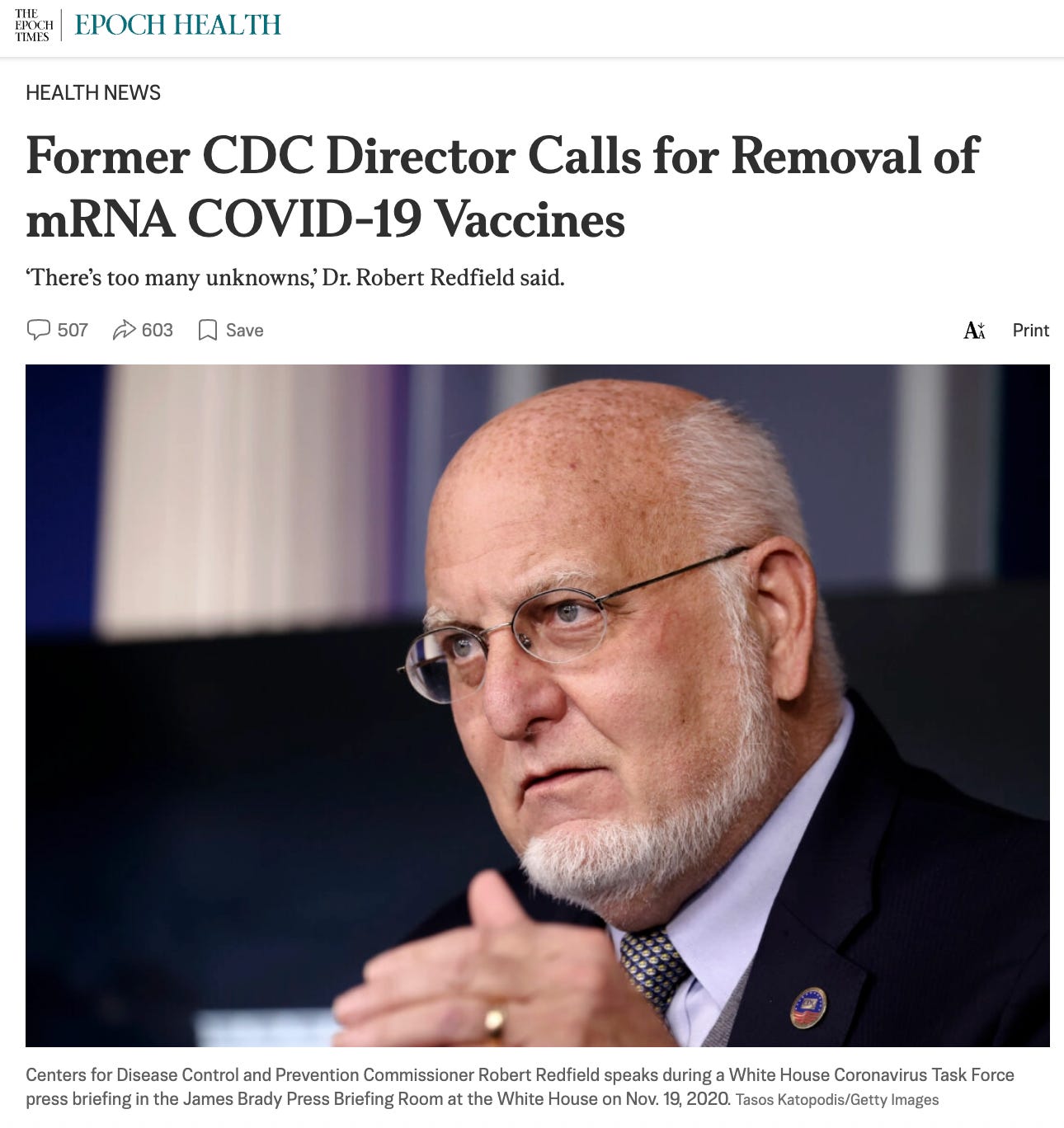
Even former CDC director Dr. Robert Redfield has now called for the removal of COVID‑19 mRNA vaccines from the market. This is not a fringe voice but a former leader of the nation’s top public health agency. His stance underscores what many have long suspected. Assurances of “safe and effective” were delivered with falsehoods.
When insiders begin to question the very products they once defended, the public is justified in reevaluating its trust in them. Redfield’s declaration is a call for accountability to return to the center of medical decision-making.
This is not about questioning for the sake of doubt, nor about reflexively refusing vaccines. It is about demanding an open, professional, and mature discussion of the evidence we already have, including the published literature, registry data, and years of observed outcomes in vaccinated versus unvaccinated children. For too long, uncomfortable findings have been sidelined or dismissed. If we are serious about science, then we must be serious about transparency, allowing the public to examine all the data and debating it honestly. Anything less is not science, but dogma.
This growing fatigue with the medical establishment has resulted in scrutiny far beyond the COVID Operation and its resulting products of experimentation (so-called “COVID Vaccines”). It has extended to questioning the entire system, rightfully so. The leaders of these dissenting sentiments are now reaching the highest levels of the orthodoxy, permeating the very institutions that uphold this system.
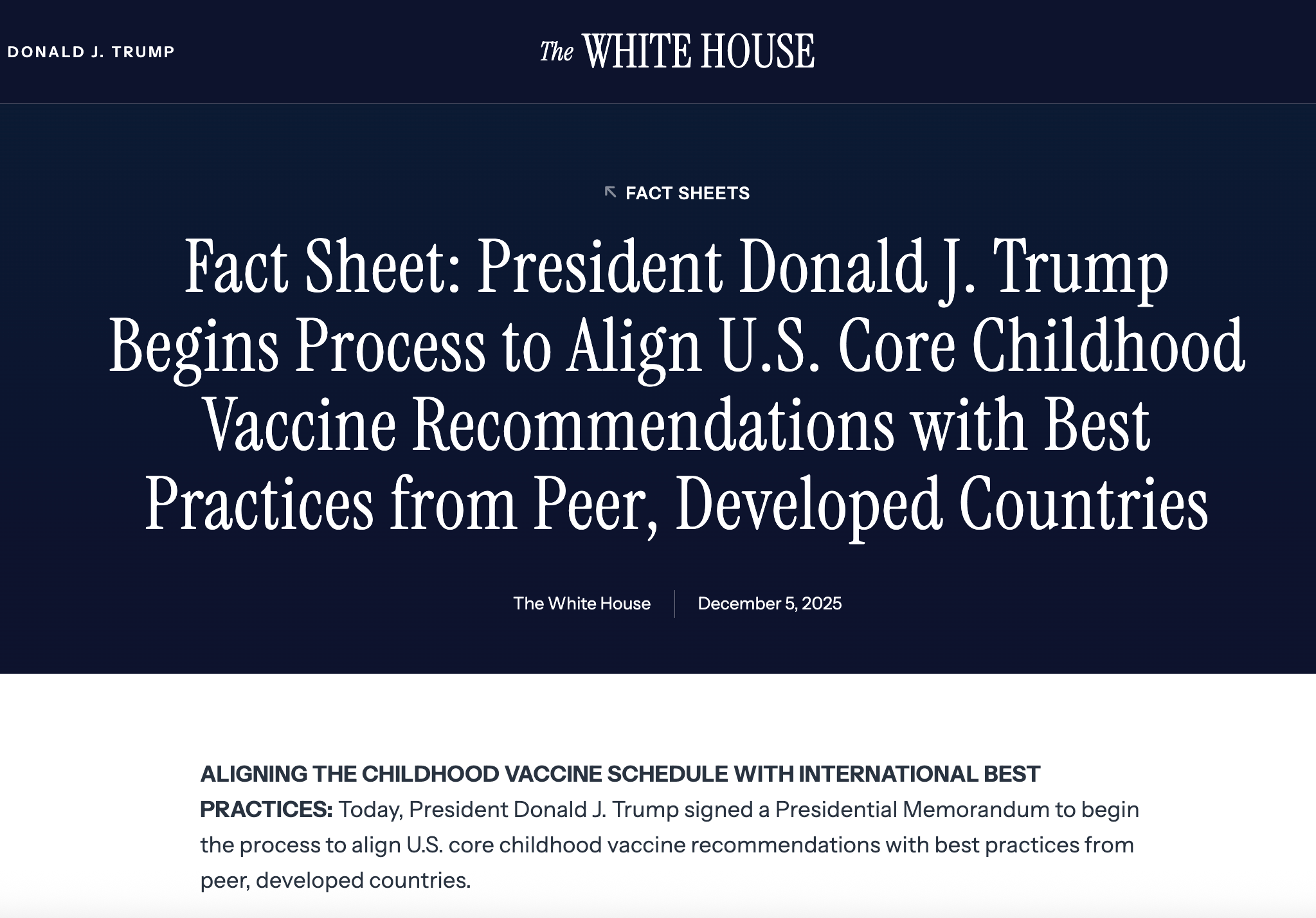
Already, this new leadership is producing paradigm-changing results. Most recently, President Trump issued a memorandum instructing the Health and Human Services Department (HHS), specifically Secretary Kennedy, to “Align U.S. Core Childhood Vaccine Recommendations with Best Practices from Peer, Developed Countries”. Personnel allegedly familiar with the situation reported that HHS is considering adopting a vaccination schedule similar to that of Denmark.
My own journey over the last five years has taken me across the world, sharing platforms in some of the most prestigious venues with the foremost visionaries in modern medicine. And despite their diverse backgrounds, these thinkers converge on a sobering interpretation of recent history: what I call “the COVID operation,” a global event whose political, social, and medical repercussions continue to reverberate. In their view, it was a profound rupture in public health practice, one whose consequences are still unfolding before our eyes.
Over the past six years, a chorus of courageous voices has risen to challenge the entrenched orthodoxy of vaccine policy and public health mandates. Foremost among them is Dr. Peter McCullough, whose works The Courage to Face COVID‑19 and Vaccines: Mythology, Ideology, and Reality dissect the medical and cultural narratives surrounding immunization. Standing beside him is Dr. Jim Thorp, the distinguished maternal-fetal medicine specialist, whose book “Sacrifice” exposes the profound ethical stakes of medical mandates and their impact on women and children.
Alongside these physicians stand figures such as Aaron Siri, whose relentless defense of informed consent, captured in his book Vaccines, Amen: The Religion of Vaccines, reminds us of the religious-like faith that is modern medical understanding, and how its clergy is aghast by the mere notion of questioning the orthodoxies. Equally influential is Del Bigtree, founder of the Informed Consent Action Network and executive producer of the documentaries Vaxxed and An Inconvenient Study, who stirred public debate and brought suppressed data to light. In the realm of pediatrics, Dr. Paul Thomas has equipped parents to navigate individualized vaccine decisions through his works The Vaccine‑Friendly Plan and Vax Facts, emphasizing long‑term health outcomes and personalized care.
Together, these figures, along with many other physicians, scientists, attorneys, and advocates, embody a movement insisting that public health must rest not on decrees but on transparency, dialogue, and respect for human agency. Their collective testimony is clear: the future of medicine belongs to those willing to speak truth and defend conscience.
We’re told the medical system is obsessed with prevention. Obsessed, through mass vaccination, with shielding us from every self‑limited illness that once passed through childhood like a brief season. But when you look past the language and into the architecture of the system, something doesn’t quite align. A structure that grows by managing illness cannot be expected to celebrate a world with less of it. It would be like an oil company suddenly promoting electric vehicles, a gesture that sounds noble, but is contradictory to its own survival.
This isn’t about accusing anyone of bad intent. It’s about recognizing the deeper truth that a system built on sickness cannot fully commit to a culture of health.
These events invite us to reflect on the future of public health. If anything, the brave new leadership at these institutions and the measures that result from it will serve to evaluate whether historic vaccine policy was beneficial or detrimental to society, and it will allow transparency enough to draw meaningful conclusions on these issues. The verdict, however, will not be immediate; only time will tell.
FIN
Biopolitiks by Dr. Alejandro Diaz
About Me
I am a Pediatric Allergist / Immunologist and Global Health Expert with extensive international experience, most recently named Chief of Pediatric Medicine at The Wellness Company. I have delivered conferences in over 30 countries around the globe on medicine, migration, biosecurity, and related topics. This includes prestigious venues such as the White House, the US Capitol, the Romanian Parliament, the European Parliament in Brussels, the Mexican Senate of the Republic, the United Nations in Geneva, Japanese Parliament, among others.
My career encompasses diverse roles in healthcare, including private practice, health systems, and advisory positions for medical service companies, governments, and government entities worldwide.
The ACIP decision really does mark somthing beyond just policy adjustment. I sat through a pediatric visit last year where the hep B discussion felt less like shared decision and more like a checkbox, so seeing this shift toward actual parental agency feels overdue. The tension between evidence-based protocol and individual context has always been there, but this openss up space for clinicians to engage parents as partners rather than recipients of mandates.
This is a good, albeit small step in the right direction, but we still have a very long way to go. I believe that all vaccines should have their FDA approval revoked until they have been scientifically proven to be "safe and effective" through long term randomized control studies including completely unvaxxed as the control group. Of course not a single vaccine will meet that criterion. Meanwhile the CDC's vaccine recommendations for children should be ditched entirely.
The next thing on our to-do list should be an equivalent re-evaluation of the conventional poison, slash and burn treatments for cancer, using people who receive only major changes in diet and lifestyle as the control group. Surgery and chemo "treatments" for DCIS (which killed my mother with metathesis to her liver) should be outlawed entirely, as it is nothing more than murder for profit.